
Doing a restaurant inventory means counting and valuing all your stock to control consumption, detect waste, and know, dish by dish, whether your business makes or loses money. Put like that it sounds simple, but there's a problem: done by hand, on paper or with a spreadsheet that drags errors along, it almost never adds up. You lose hours counting, you value by eye, and the end-of-month discrepancy shows up without you knowing where it comes from.
Sound familiar? You're not the only one. In this guide you'll see how to do your restaurant inventory step by step: the orderly process, the mistakes you must avoid, the difference between theoretical and real inventory, and how to automate it to stop losing time and margin.
What a restaurant inventory is (and isn't)
Here's the first misunderstanding worth clearing up before learning how to do a restaurant inventory: it's not just about counting what's in the storeroom.
Counting is the visible part, but a well-done inventory is actually three things at once:
- It's stock control, because it tells you what you have and what you're missing so you don't run out of product in the middle of the rush.
- It's economic valuation, because every product you count has a cost, and the sum of all that stock is money sitting idle on your shelves.
- And it's consumption control, because by comparing what came in, what you sold, and what's left, you discover how much your kitchen is really spending.
That's why an inventory isn't just another administrative task you do out of obligation and file away. It's a profitability tool: the most honest mirror you have to know whether your restaurant makes or loses money on each dish.
Theoretical inventory vs. real inventory: the difference that costs you money
If you only count what's on the shelf, you're missing half the picture. The real value of an inventory appears when you compare two figures that almost never match: what should be there and what actually is.
What theoretical inventory is
Theoretical inventory is what your restaurant should have according to the numbers: the opening stock, plus what you bought (your delivery notes), minus what you sold according to each dish's recipe costing. It's a figure that comes from your data, not from physically counting. In theory, it's what should be on your shelves right now.
What real inventory is
Real inventory is what you find when you go, count, and weigh product by product. No formulas, no assumptions: what's there, what you see. It's the physical figure.
Shrinkage: where the discrepancy appears
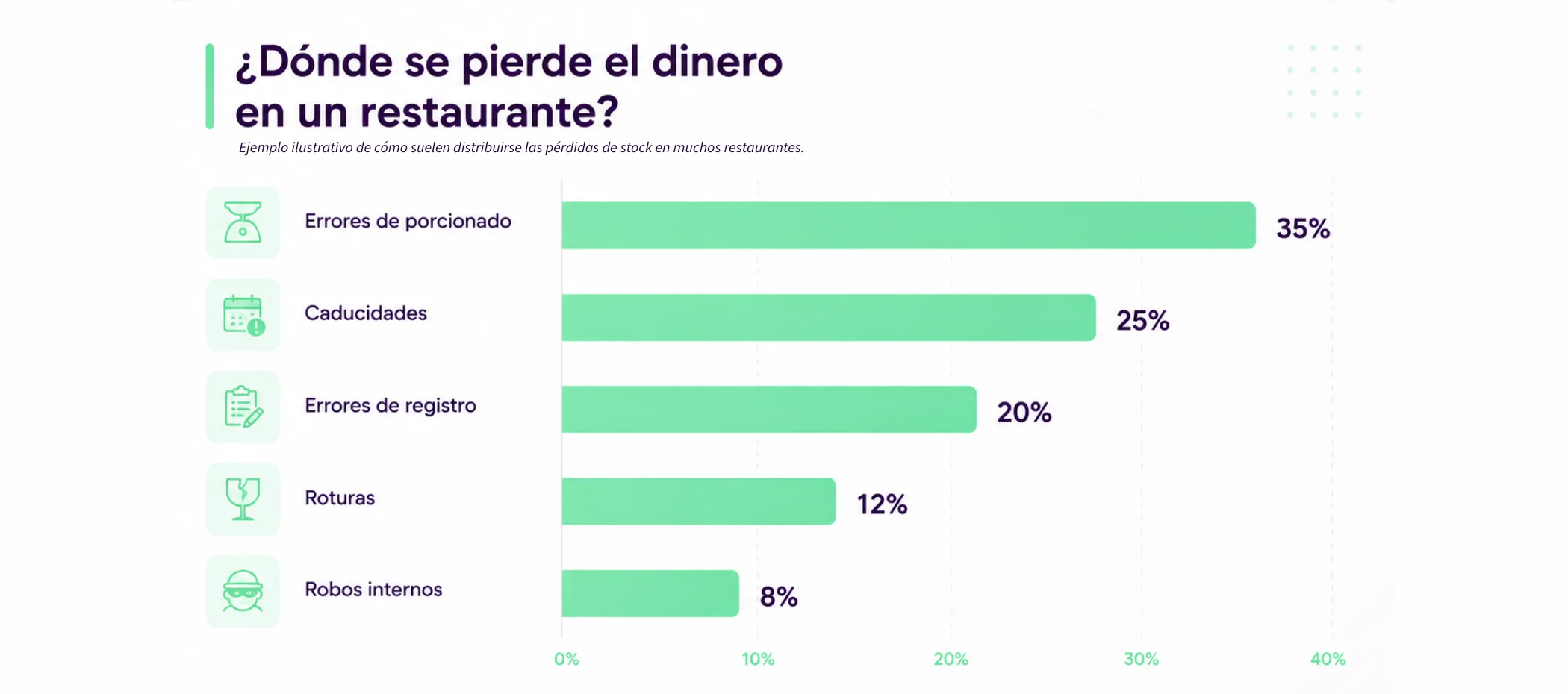
Between the theoretical and the real there's almost always a gap, and that gap has a name: shrinkage. That's where expired product, pilferage, oversized portions, errors recording a delivery note, or careless portioning hide. The bigger that discrepancy, the more money is slipping away without you seeing it. Measuring it is the first step to plugging the hole.
How to do your restaurant inventory step by step
With the theory clear, let's get practical. Learning how to do a restaurant inventory isn't about putting in hours, but about always following the same method. These are the steps so it stops being a headache and starts giving you useful information.
1. Define the frequency
Not everything is counted at the same frequency. Fresh, perishable products (fish, meat, vegetables) should be checked daily or every other day, because that's where shrinkage builds up fastest. The cellar, canned goods, and dry products can handle weekly or monthly control. The key is consistency: an inventory done at the wrong time, whenever you remember, is useless for comparing anything. Mark fixed days on the calendar and respect them like another reservation.
2. Categorize and organize your products
Trying to count jumping from the fridge to the storeroom and from there to the bar is the perfect recipe for getting lost and double-counting. Group your goods into families (meats, fish, dairy, drinks, dry goods…) and, within each one, follow the physical order in which they're arranged in your venue. That way you walk the shelves once, logically, without backtracking. Good order doesn't just speed up the count: it cuts errors almost in half.
3. Define clear units of measure
This is where many people trip up. If one day you record oil in liters, another in bottles, and another in boxes, your numbers will never be comparable. Decide on one unit per product and always keep it: kilos for meat, liters for liquids, units for what's counted one by one. And make sure the whole team uses the same criterion. It seems like a minor detail, but it's one of the main causes of discrepancy in a restaurant inventory.
4. Always count the same way and in the same order
An inventory only works if you can compare one with the next, and for that the method has to be identical every time. Always start in the same area, walk the shelves in the same direction, and count each product the same way. If possible, have the same person always do it or, at least, two people with the same criterion. That routine removes doubts like "did I already count this?" and makes this week's data and next week's speak the same language.
5. Record and value the stock
Counting is half the job; the other half is putting a price on it. It's not enough to know you have 12 kilos of sirloin: you need to know what it's worth. Note its cost next to each quantity, and in the end you'll have the real economic value of your whole storeroom. That number is gold: it tells you how much money you have tied up in stock, which products concentrate the most capital, and where you might be overbuying. An inventory without valuation tells you what you have; one with valuation tells you what it's costing you.
6. Compare theoretical vs. real and analyze deviations
We reach the step that gives meaning to all the previous ones. Take your real inventory (what you counted) and pit it against your theoretical inventory (what you should have according to purchases and sales). The difference is your shrinkage. If it's small, you're doing well. If it's large or repeats on the same products, there's your signal: uncontrolled portioning, a supplier that doesn't deliver what it invoices, breakages, or, outright, leaks.
Step 6 is also where paper and Excel fall short: calculating the theoretical figure by hand, cross-checking delivery notes and recipe costings one by one, is slow and error-prone. This is where it makes sense to lean on a management tool like Prezo, which calculates theoretical inventory automatically from your purchases and recipes; shows you deviations and shrinkage in real time; and warns you of expirations and stockouts before they become a problem. What used to take you a morning of spreadsheets, you have on a single screen.
The most common inventory mistakes (and how to avoid them)
Knowing how to do a restaurant inventory also means recognizing the mistakes that ruin it. These are the most common ones (and we'll give you some tips to dodge them):
Counting by eye or "more or less". The "I reckon there's about half a box" is the start of the discrepancy. Weigh and count for real, even if it takes an extra minute. Today's precision is tomorrow's reliable figure.
Counting quantity but not valuing. Knowing you have 8 bottles of wine tells you nothing without their cost. Without economic valuation, the inventory is a pretty count that's useless for making decisions.
Doing it with the venue open. If products come in and out while you count, the result is dead on arrival. Always do inventory with the kitchen stopped: before opening or after closing.
Trusting your memory. "I already counted this", "I think we ordered double"… Memory lies. Write everything down on the spot, never at the end.
Not involving the team. If each shift counts its own way, the numbers don't add up. Define a single method and have everyone follow it the same way.
Changing the criterion every time. Today in boxes, tomorrow in units; this month you include the bar, next month you don't. Without a stable system, there's no possible comparison and shrinkage becomes impossible to track.
Most of these mistakes share a common root: a manual, scattered process that depends on the goodwill of whoever's counting. Standardizing the method (or simply digitizing it) is what makes them disappear.
Why Excel and paper are failing you
If you've made it this far, you already sense the underlying problem: no matter how organized you are, doing your restaurant inventory on paper or with a spreadsheet has a ceiling. And you hit it fast.
Paper gets lost, gets stained, and no one looks at it again. Excel holds up better, but it drags its own vices: a formula someone broke by accident three months ago, cells that don't update, data that depends on someone entering it correctly every day. A single typo and the discrepancy spreads without you noticing.
But the bigger problem isn't that. It's that neither paper nor Excel is connected to the rest of your operation. They don't know what you bought according to your delivery notes, they don't know your recipe costings, they have no idea what you sold. And without that connection, calculating theoretical inventory becomes manual work, slow and almost impossible to keep up to date. You end up with a snapshot of what's there, but never the full picture of what should be there.
The result: you spend hours on a task that gives you half-data, always late and almost never reliable. There's a better way to do it: automate 👇
How to automate your restaurant inventory
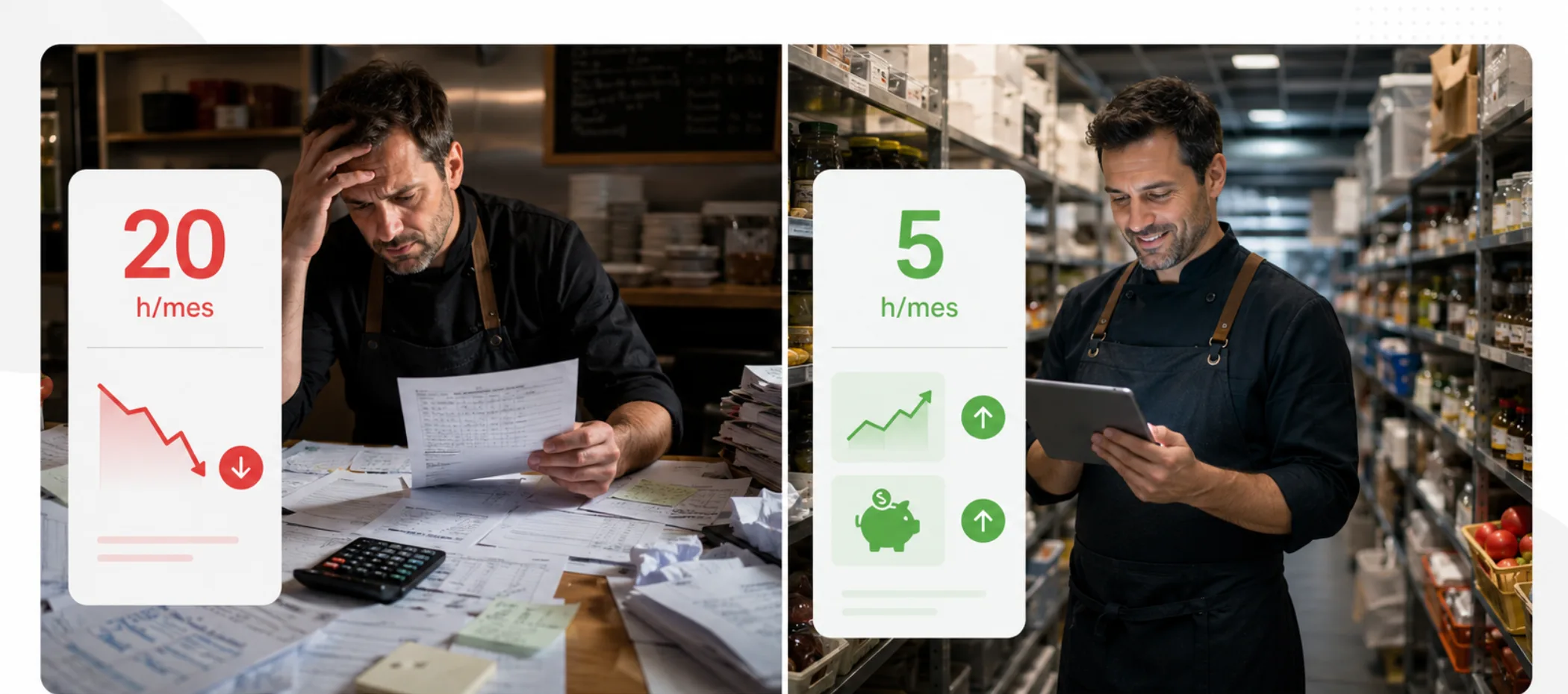
Automating your restaurant inventory doesn't mean you stop counting: the physical count is still necessary. What changes is everything else. Instead of fighting with formulas and paper, you let the system do the heavy lifting: cross-referencing data, calculating the theoretical figure, and warning you when something doesn't add up.
A management tool like Prezo connects your purchases, your recipe costings, and your stock in one place. What does that mean day to day? That theoretical inventory is calculated on its own from your delivery notes and recipes, without you having to cross-check anything by hand. That you see deviations and shrinkage in real time, not at month-end when you can no longer do anything. And that the system warns you of expirations and stockouts before they turn into thrown-away product or a dish you can't serve.
On top of that, generating the inventory sheet stops being torture: you have it ready to count, organized by families, and you pour the data in within minutes. What used to be a whole morning of Excel becomes a quick task that, on top of it, gives you reliable information to decide.
The result is what any good management promises: more control, less wasted time and, above all, less money slipping down the drain without you seeing it.
Want to see how it would work for your business? Request a Prezo demo and find out how much time (and how much margin) you can get back.
Frequently asked questions about restaurant inventory
How often should you do a restaurant inventory?
It depends on the type of product. Fresh and perishable items (meat, fish, vegetables) should be counted daily or every other day, because they generate shrinkage fast. Canned goods, drinks, and dry products allow weekly or monthly control. What matters is being consistent and always doing it on the same days, so you can compare from one period to another.
How long does it take to do an inventory?
By hand, a small venue can run to one or two hours, and considerably more if the storeroom is messy or the units aren't clear. With a standardized method and a tool that generates the inventory sheet and calculates the theoretical figure, that time drops drastically: the physical count stays, but all the subsequent calculation work disappears.
What is shrinkage and how much is acceptable?
Shrinkage is the difference between what you should have (theoretical inventory) and what you actually have (real inventory). It includes expirations, breakages, pilferage, and portioning errors. There's no universal figure, but shrinkage that grows month after month or always concentrates on the same products is a clear sign that something is slipping away.
Can you do a restaurant inventory without software?
Yes, you can with paper or Excel. The problem isn't counting, it's everything else: cross-checking delivery notes and recipe costings by hand to calculate the theoretical figure is slow and error-prone, and the information almost always arrives late. That's why, as soon as the business grows, knowing how to do a restaurant inventory reliably usually means digitizing the process.