
I'll start with the facts, no opinions. Here's the deal: Brussels has put a number on the table. The VAT hike in hospitality from 10% to 21% recommended by the European Commission would increase state revenue by almost 7 billion euros a year, around 0.4% of GDP.
From what I read, the recommendation is not binding. Yet 🫤
But the sector is already up in arms. The industry associations call the measure "catastrophic": job destruction and a drop in demand.
I think they're partly right. Eleven points of VAT are not a nuance, they're a direct blow to any restaurant's bottom line.
But I want to say something you may not entirely agree with: that hike is not going to sink everyone equally. And the difference won't be about who protests the loudest.
I've spent years watching how the real numbers of the restaurant business work. And I've learned that a shock like this doesn't kill weak businesses; it flattens the margin cushion that was hiding the problems that already existed.
The restaurant that knows exactly how much it makes per dish can maneuver. It knows what to raise, what to touch and what to leave alone. The one that bills well but operates blindly can't. That one discovers the hole when it's already too late.
That's why this article won't be another lament from the sector. There are already enough.
It's about how the VAT hike really affects restaurants. About what changes in your margin the day it comes into force. And about who survives and why.
Spoiler: it's not a matter of luck. It's a matter of cost control.
What exactly Brussels has asked for
Here I'd like to separate the noise from the fact.
The European Commission has included the measure in its latest batch of fiscal recommendations to Spain. The approach is clear: review the reduced VAT rates currently applied to hotels and restaurants, set at 10%, and raise them to the general rate of 21%.
The cost of keeping that reduced rate is high. According to a report by AIReF, the independent Spanish fiscal authority, raising hospitality VAT from 10% to 21% would increase revenue by almost 7 billion euros a year. That's the equivalent of 0.4% of GDP.
It's worth understanding that number well. It's not money the State loses. It's money it currently gives up collecting to keep the 10% reduction. In fiscal jargon it's called a "tax benefit": an exception that has a cost for public coffers.
But Brussels' argument isn't only about revenue. And this nuance matters.
The Commission maintains that reduced VAT has "a very limited redistributive effect". Why? Because in practice it benefits high incomes more than low ones. They are the ones who consume the most in restaurants and hotels. And therefore the ones who take the most advantage of the reduced price. In other words: for Brussels, we're not protecting whom we thought we were protecting.
Now, the most important thing so as not to over-worry:
The recommendation is not binding. For now it's just that, a recommendation. There is no legal obligation to apply it.
But it arrives at a moment of growing fiscal pressure on the Government. And it opens a political front that won't close on its own. There's a precedent, too. When Portugal and Ireland raised hospitality VAT during the 2012 crisis, under European pressure, the effects were negative enough that both backtracked. They restored the reduced rates a few years later.
That tells us two things.
- One: the risk is real, not theoretical.
- Two: not even the Governments that applied it sustained it over time.
The question, then, is not only whether it will arrive. It's what you do in the meantime — how do you protect your business?
What the VAT hike does to your bottom line (dish by dish)
Let's get to the question that matters. How does the VAT hike affect your restaurant in practice? Not in headlines. In your bottom line.
First, a technical detail many people overlook. VAT is not your cost. The customer pays it. You only collect it and hand it to the tax authority.
But that's the trap.
Those 11 extra points have to come from somewhere. And there are only two options.
Option A: you pass it on to the customer. You raise the menu prices to keep your base. A 11€ dish with VAT goes up to about 12.10€.
Option B: you absorb it. You keep the menu price. But from each ticket, more money goes to the tax authority and less stays in your till.
Let's see it with a simple example. A dish at 11€ with VAT at 10%:
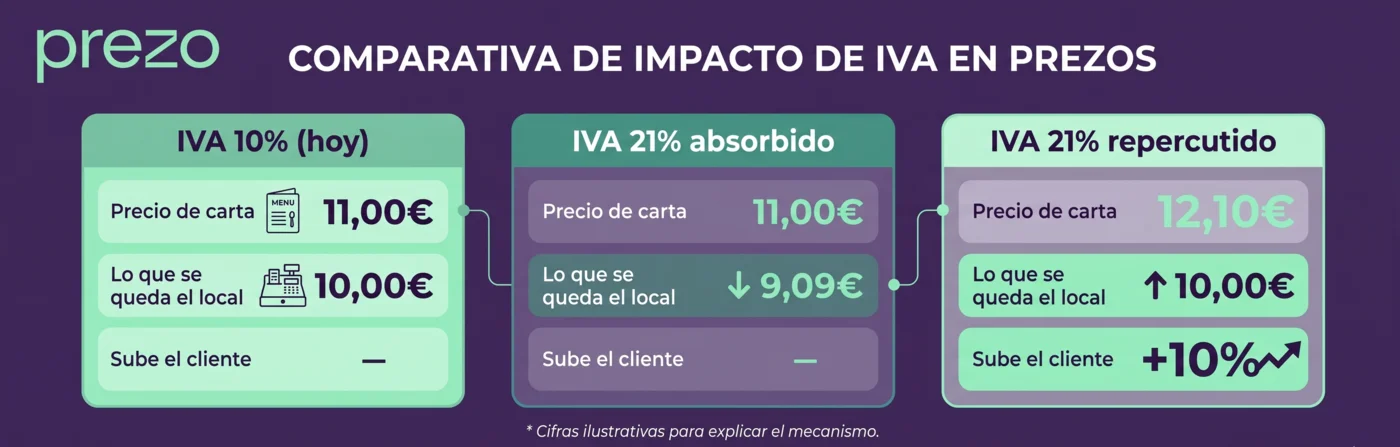
Look at the middle option. If you absorb the tax, you keep 9.09€ instead of 10€. Almost a euro less per dish. That comes straight out of your margin.
Here comes the false way out. "I'll just raise everything for the customer and that's it."
If only it were that easy.
The problem is called demand elasticity. People don't pay just any price. You raise the whole menu by 10% and some of your customers stop coming, or order less.
In a neighborhood daily-menu spot, the room to raise prices is almost nil. In a destination restaurant with loyal clientele, there's a bit more leeway. Not all businesses can take the same.
That's why the real way out is not to raise everything blindly. It's to know which dish can take an increase and which can't.
And here come two concepts that are constantly confused: food cost and margin.
Food cost is what it costs you to produce the dish. The margin is what's left after everything. They're not the same.
You can have a dish with a low food cost and a terrible margin. Or the other way around. Without measuring it, you don't know.
And that's the point. To increase your margin in restaurants in the face of a tax hike, you first have to know where it is today. Dish by dish.
Whoever has real cost control in hospitality knows this:
- Which dishes have a cushion to absorb part of the blow.
- Which already run so tight that any increase pushes them into losses.
- Where they can touch price without scaring off the customer.
Whoever doesn't have it decides blindly. Raises everything equally. Or absorbs everything out of fear. Both come at a high price.
The VAT hike in hospitality doesn't invent this problem. It just exposes it.
Because while the margin is wide, not measuring is free. When it narrows, it stops being free.
And eleven points narrow a lot of margin.
Who survives a hike like this, and how?
What I've been telling you: the one who survives is the one who knows their numbers before the blow arrives. Not the one who reacts when they're already in it.
And knowing the numbers isn't checking the till at the end of the month. It's having visibility over the five areas that decide profitability: sales, purchasing, stock, kitchen and staff.
They don't work separately. They work as a system. Touching one without looking at the others is deciding blindly.
This is what I would do now, without waiting for the measure to be approved:
- Re-cost with real costs. Not with prices from six months ago. Suppliers have already raised theirs. If your costing is outdated, your margin is an illusion.
- Identify the dishes that already run tight. Before touching the menu, you have to know which dishes have a cushion and which don't. Raising everything equally is the costliest mistake.
- Close the leaks nobody looks at today. The waste that isn't weighed. The delivery note that isn't cross-checked with the invoice. The dish served larger than the recipe says. That's where the margin goes, drop by drop.
- Touch prices with criteria, not with fear. Raise where the customer can take it. Hold where it's sensitive. That's only decided with data, not intuition.
The difference between surviving and not isn't the size of the business. It's whether you have cost control or you go by eye.
VAT is decided by Brussels. Your margin is decided by you.
And when the cushion disappears, the one who already knew where every euro was wins.
Your margin is decided by you
Let's go back to the beginning. The VAT hike in hospitality is not going to sink everyone equally.
It will sink the one who discovers their numbers when it's already too late. The one who raises the whole menu blindly and watches the place empty out. The one who absorbs the blow out of fear until they're left with no margin.
The other one will survive. The one who knows, dish by dish, where they gain and where they lose.
Because how the VAT hike affects restaurants doesn't depend only on Brussels. It depends on how prepared you are when it arrives.
The tax doesn't create the problem. It just exposes the one that was already there, covered by a wide margin that forgave not measuring.
That's why the answer isn't to protest louder. It's to have real cost control in hospitality. To know your real food cost, dish by dish. To understand what can be touched and what can't.
That's the only way to increase your margin in restaurants when the context turns against you. Not with luck. With data.
I've been seeing it for years. The businesses that withstand the blows aren't the biggest ones. They're the ones that know exactly where every euro is.
VAT is decided by Brussels.
Your margin is decided by you.