
In August 2025 a completely new hospitality collective agreement came into force in the Balearic Islands, running until 2028. It is not an extension of the previous one, nor a pay review: it is a different text, with its own rules on working hours, shifts, rest periods and holidays, designed for a sector where headcount doubles in spring and halves in autumn. If in 2026 you are still working from information based on the previous agreement, it is easy to end up applying terms that no longer apply.
In this article we go over which agreement is in force right now, who it applies to, how many hours can be worked per year, how shifts are organised in high season, what rest periods apply between shifts and within the week, and how holidays and the return of permanent-seasonal staff are planned when the season starts.
Which hospitality agreement is in force in the Balearics in 2026
In 2026 the agreement in force is the XVII Sectoral Collective Agreement for Hospitality of the Autonomous Community of the Illes Balears, published in the BOIB on 5 August 2025 and with pay effects from 1 April 2025. It runs until 31 March 2028, with automatic renewal year on year unless either party formally terminates it.
Unlike other Spanish regions, there is no situation of extended validity here and no open negotiation: it is a new agreement, closed and with a three-year horizon, which gives a little more stability when planning ahead.
Who the Balearic hospitality agreement applies to
The agreement covers restaurants, bars, cafés, hotels, catering and every other hospitality business operating in the Illes Balears, whether the activity is seasonal or year-round. It regulates both permanent staff and permanent-seasonal (fijo-discontinuo) contracts, a particularly relevant arrangement in a sector where much of the team comes and goes with the season.
Working hours and how working time is organised
The agreement sets a maximum of 1,776 effective working hours per year, with an approximate average of 40 hours per week. In high season, days of up to 12 hours are allowed, provided they are split shifts and a minimum 2-hour break is respected between the two stretches.
This is probably the most distinctive feature of the Balearic agreement compared with other regions: the rules explicitly recognise the summer activity peak and allow hours to be concentrated in the strong months, always within clear limits.
How schedules and shifts are organised
Schedules must be communicated at least 5 days in advance, which in practice forces you to plan the season with some margin rather than improvising the rota booking by booking. With teams that grow suddenly in spring and shrink just as fast in autumn, keeping that planning in a shared spreadsheet becomes unreliable as soon as the team passes a certain size: a last-minute change that does not reach everyone, or a rota two people are editing at the same time, and the notice stops arriving on time. The result is a shift change the employee can refuse for not respecting the notice period, and one that, if an inspection comes along, you cannot prove was communicated when it should have been, because it was never recorded anywhere.
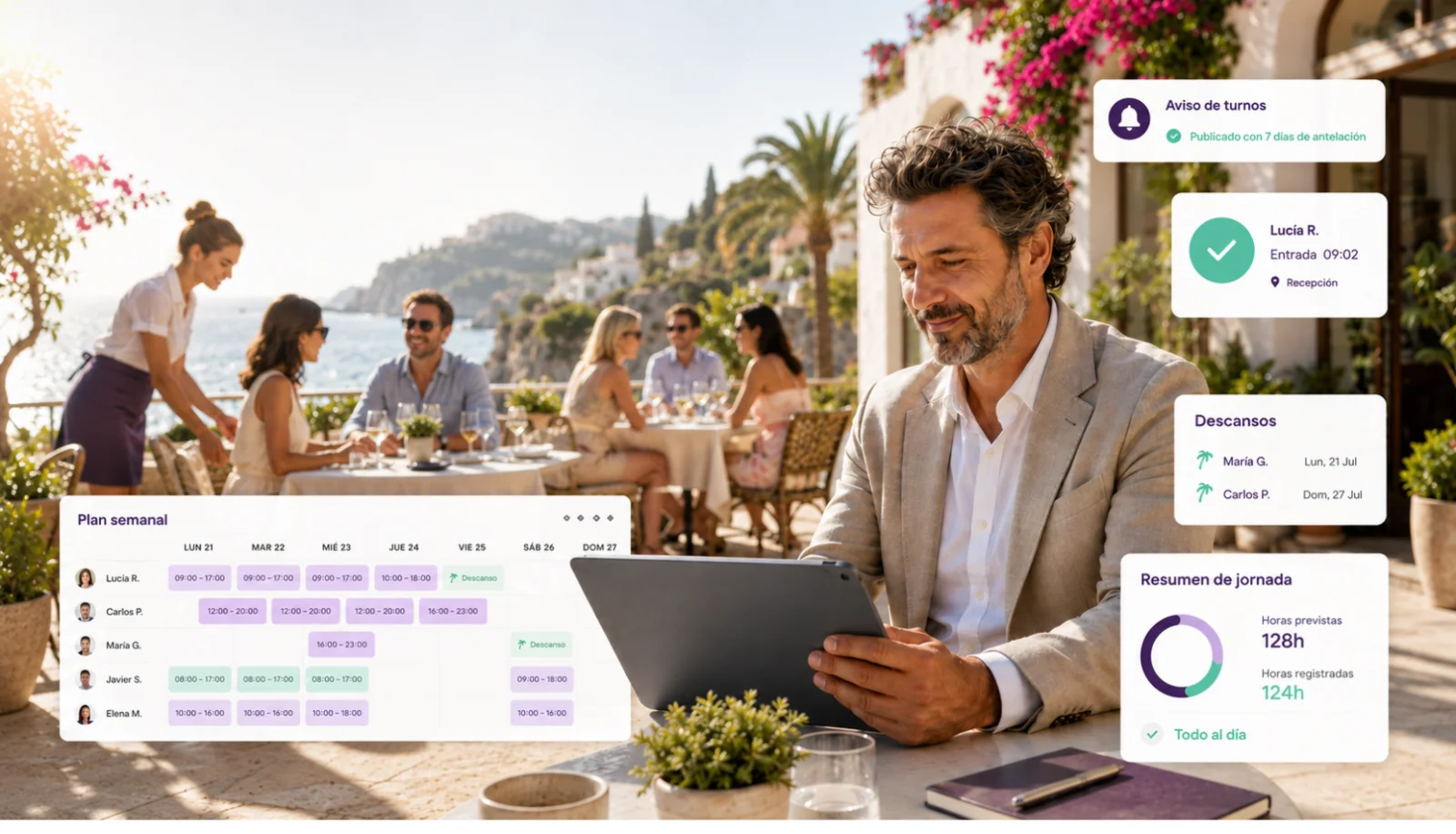
That is exactly the point — keeping the rota always up to date and every change notified and recorded — that we solve with Prezo's shift management and planning. The rota is published straight to each team member's phone as soon as it is ready, so a shift change does not depend on someone remembering to send a WhatsApp. And because the system knows the rules of the agreement, it warns automatically if a change leaves someone below the minimum rest between shifts, before the rota is published rather than after the breach has happened.
Daily and weekly rest periods
Between the end of one shift and the start of the next, a minimum rest of 12 hours must be respected. Weekly rest is set at a continuous day and a half, although the agreement allows it to be accumulated over periods of up to 14 days in high season, so the team can concentrate its rest instead of spreading it week by week through the busiest months.
Holidays and absence planning
Staff are entitled to 30 calendar days of holiday per year. The agreement requires that at least 15 days are taken between October and April, precisely to avoid the whole team requesting holiday in the middle of summer and to spread the workload outside the high season.
What makes staff planning different in hospitality
Seasonality also shows in how permanent-seasonal staff are brought back: the agreement regulates the call-up of these workers at the start of each season, with notice and response periods that are worth planning carefully so you do not reach opening day short-staffed.
Time tracking and working-time records
As everywhere else in Spain, the obligation to record each employee's working day daily is a general legal requirement, not just an agreement one. In a business with split shifts, hours concentrated in high season and permanent-seasonal staff coming and going, that record gets complicated fast if it is kept by hand.
Prezo's time tracking records clock-ins, clock-outs and breaks automatically throughout the season, without depending on paper timesheets that then have to be reconciled by hand when the season closes.
Prezo in high season: shifts and hours without surprises
At Prezo we work with seasonal businesses living exactly this reality: teams that grow and shrink with the time of year, hours concentrated into a few months, and the need to comply with an agreement that has its own rules for accumulating rest and holidays. Our shift planning and time tracking solutions are built so that this management does not depend on loose spreadsheets that change every season, nor on someone remembering by hand who has the most accumulated rest days or when it is time to call permanent-seasonal staff back for opening. If you want to see how we do it at Prezo, get in touch.
Frequently asked questions
Which collective agreement is in force in the Balearics in 2026?
The XVII Sectoral Collective Agreement for Hospitality of the Illes Balears, published in the BOIB on 5 August 2025 and in force until 31 March 2028.
How many hours can be worked per year?
A maximum of 1,776 effective hours, with an approximate average of 40 hours per week.
Can staff work more than 8 hours a day in high season?
Yes, up to 12 hours a day on split shifts, always respecting a minimum 2-hour break between the two stretches.
How many holiday days are there and how are they spread out?
30 calendar days a year, of which at least 15 must be taken between October and April.
How much notice is required for schedules?
A minimum of 5 days notice.