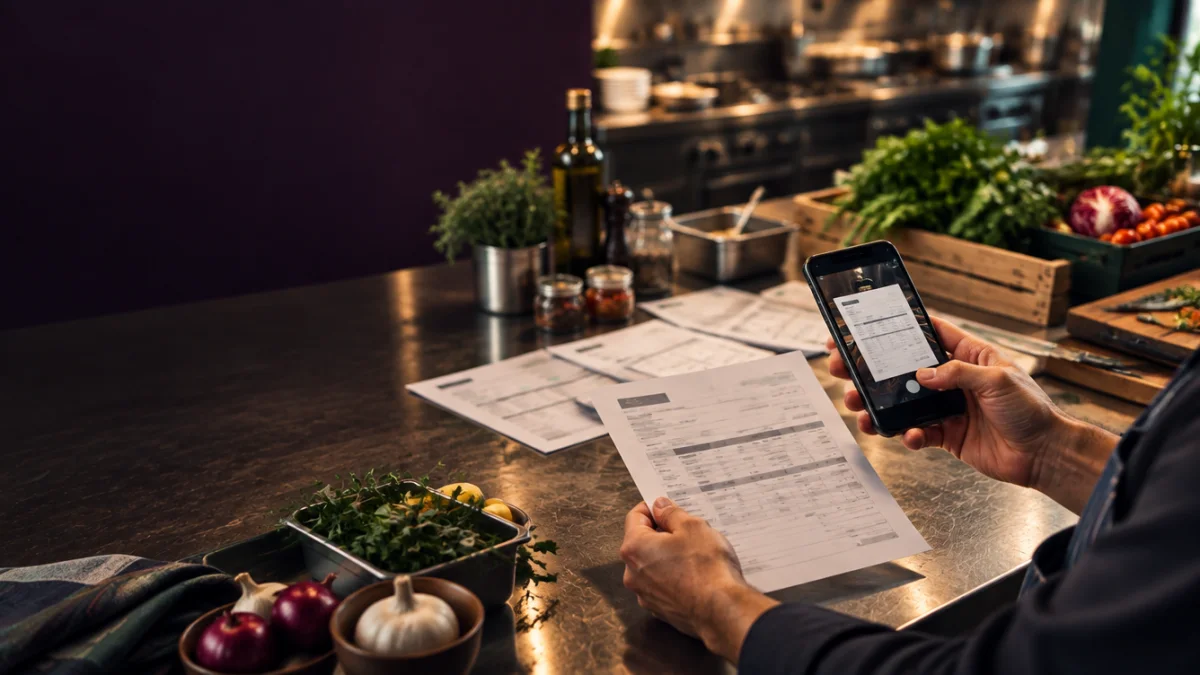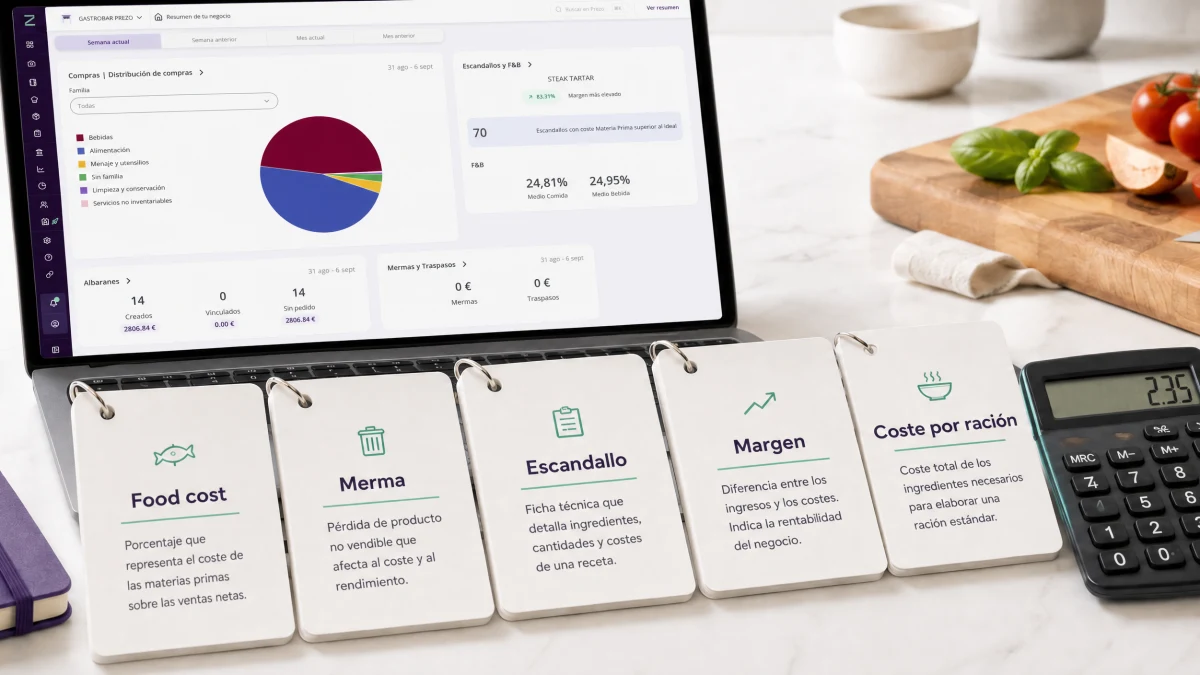
A dish can sit on your menu for months with a margin that no longer exists, and nobody knows until someone sits down to recalculate. All it takes is an ingredient going up in price, a quantity changing in the kitchen, or waste that nobody accounted for, and the real cost of a recipe drifts away from the one used to set the selling price. The food cost sheet is the tool that stops that going unnoticed.
In this guide we explain how to go from a purchase price to a real cost per ingredient, how waste and yield affect the calculation, how to get the total cost and the cost per portion, and we work through a complete example, figure by figure, so you can apply it directly to your own recipes.
What a food cost sheet is
A food cost sheet is the calculation, ingredient by ingredient, of what the raw materials needed to make a recipe cost. It is not an estimate or an average: it is the exact sum of the cost of each component, in the quantity actually used, to arrive at a total cost and a cost per portion.
From purchase price to real ingredient cost
The price on the supplier's delivery note is almost never the real cost of the ingredient on the plate. Between what you buy and what reaches the plate there are losses: skin, bones, trimmings, cooking water, product that spoils. That percentage which is actually used is called the yield, and it is the piece that turns a purchase price into a real cost.
How to calculate the cost of each ingredient
The calculation, ingredient by ingredient, follows this logic:
Purchase price ÷ yield = yield price (the real cost per kilo, litre or unit, with waste already built in)
Yield price × quantity used in the recipe = cost of the ingredient
When the yield is 100 % — as happens with many packaged or pre-cleaned products — the yield price matches the purchase price and the calculation simplifies.
How waste affects the real cost
Waste is the difference between what is bought as raw weight and what is finally used on the plate. A vegetable that loses skin and trimmings when cleaned, a cut of meat that loses weight when cooked, or a fish filleted before plating: in every case, the kilo you bought is not the kilo you serve.
Ignoring waste is one of the most common mistakes when building a cost sheet, and also one of the ones that most inflates the margin on paper without it actually existing.
How to calculate the total cost of a preparation
The total cost of the recipe is, quite simply, the sum of the cost of all its ingredients: the headline ones and also the ones taken for granted, such as oil, salt or the side. Leaving these last ones out because they seem insignificant is another frequent mistake, because on a dish that leaves the pass hundreds of times a month, those loose cents add up.
How to get the cost per portion
If the recipe is made for several portions at once — a stock, a base sauce, a side shared between several dishes — the total cost is divided by the number of portions that preparation yields. The result is the cost per portion, the figure that is actually compared with the selling price.
A complete food cost sheet example
Let's look at an example with a gourmet burger for one portion. The prices are fictional and purely illustrative: every restaurant has to build its cost sheet with its own purchase prices and yields.
| Ingredient | Net quantity | Yield | Purchase price | Yield price | Cost |
|---|---|---|---|---|---|
| Chicken breast | 150 g | 92 % | 7.20 €/kg | 7.83 €/kg | 1.17 € |
| Brioche bun | 1 unit | 100 % | 0.40 €/unit | 0.40 €/unit | 0.40 € |
| Cheddar cheese | 30 g | 100 % | 9.00 €/kg | 9.00 €/kg | 0.27 € |
| Bacon | 15 g | 100 % | 7.50 €/kg | 7.50 €/kg | 0.11 € |
| House sauce | 20 ml | 100 % | 5.00 €/l | 5.00 €/l | 0.10 € |
| Lettuce | 15 g | 70 % | 1.80 €/kg | 2.57 €/kg | 0.04 € |
| Tomato | 30 g | 90 % | 2.00 €/kg | 2.22 €/kg | 0.07 € |
| Potatoes (side) | 150 g | 80 % | 1.20 €/kg | 1.50 €/kg | 0.23 € |
| Oil, salt and spices | — | — | — | — | 0.12 € |
| Total cost of the recipe | 2.51 € |
At a selling price of 13.00 €, the food cost of this dish would be 2.51 ÷ 13.00 × 100 = 19.3 %. If the price of chicken or potatoes goes up tomorrow, that percentage changes, and you will only know if the cost sheet is up to date.
Why the cost of a dish changes over time
A cost sheet is not a calculation you do once and leave fixed. Purchase prices vary, sometimes several times a month; suppliers change rates or formats; a recipe gets adjusted in the kitchen. Each of those changes moves the real cost of the dish, however slightly. A cost sheet that is not updated stops representing the reality of the business within weeks.
From real cost to profitability analysis
Knowing the cost of a dish is the first step, not the last. With that figure you can compare which dishes leave a better margin, which ones are worth reviewing, and which are being sold almost at cost without anybody noticing. That menu profitability analysis is what turns a cost sheet into a decision-making tool.
The calculation, done once and always up to date
Prezo's cost sheet module automatically calculates the cost of every recipe from real purchase prices, and updates it the moment an ingredient's price changes, across every dish that uses it. At Prezo we have seen that this is one of the points where most time is lost when it is managed by hand (recipe by recipe, every time a supplier puts prices up) and also one of the quickest to pay back when automated.
If you already know how a cost sheet is calculated and want to see the full process from start to finish, our guide on how to build a kitchen cost sheet explains it step by step.
Frequently asked questions
How do you work out the real cost of an ingredient?
By dividing the purchase price by the yield to get the yield price, and multiplying that result by the quantity used in the recipe.
What is the yield of an ingredient?
The percentage of product actually used in the dish after cleaning, peeling or cooking, compared with what was bought as raw weight.
How do you get the cost per portion?
By adding up the cost of every ingredient in the recipe and dividing the total by the number of portions that recipe yields.
How much did the burger in the article example cost?
2.51 € of raw materials per portion, which at a selling price of 13 € works out at a food cost of 19.3 %.
Why does the cost of a dish change over time?
Because purchase prices vary, suppliers change rates or formats, and recipes get adjusted in the kitchen; any of these changes moves the real cost.