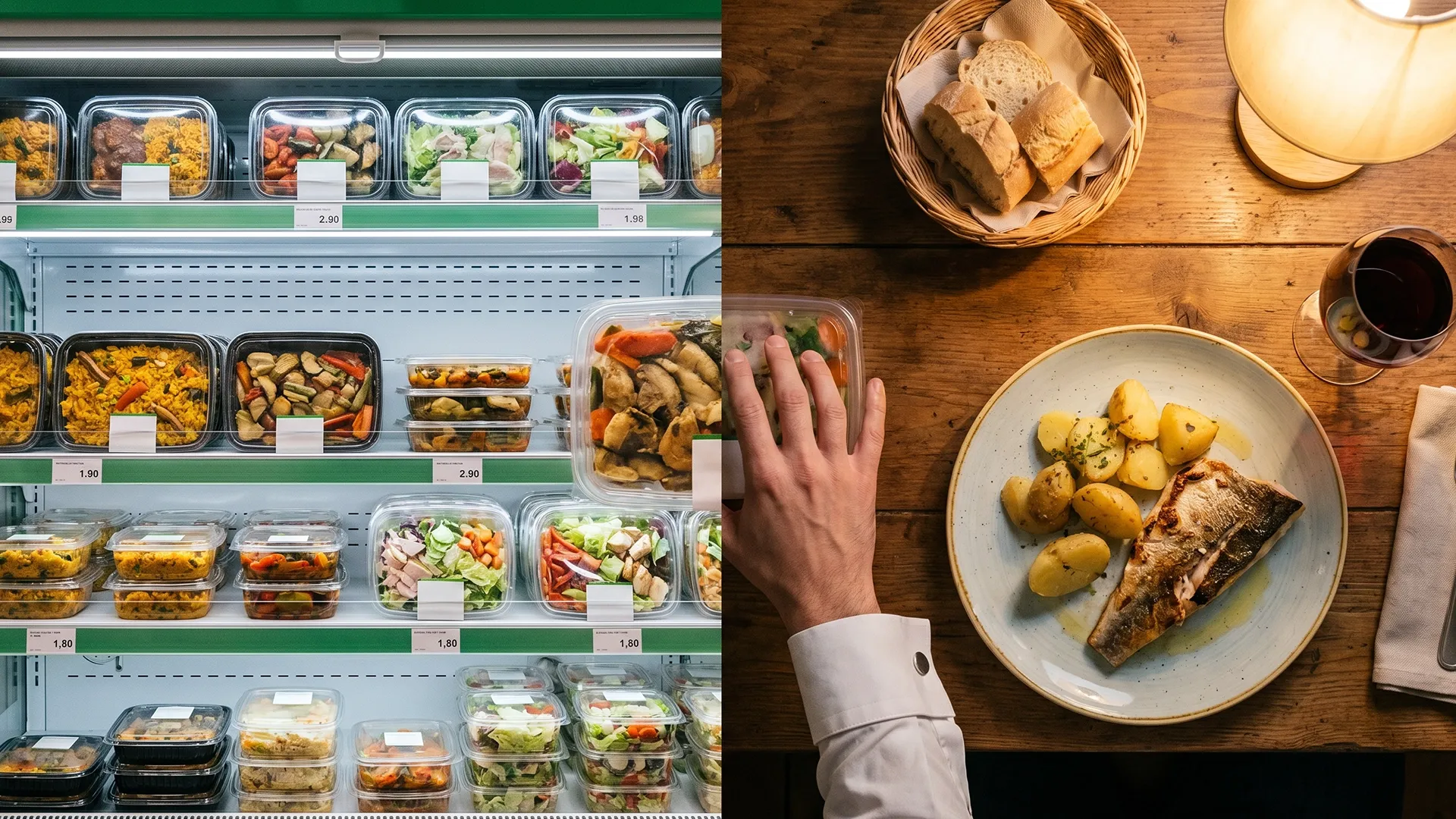

The controversy is already served. At its latest General Assembly, and in front of the Minister of Industry and Tourism, Jordi Hereu, the president of Hostelería de España, José Luis Álvarez Almeida, was very clear: there are supermarkets, petrol stations and hypermarkets that "want to be bars", and that (according to the trade association) is unfair competition. The underlying demand is well known: if you sell ready-to-eat food, you should meet the same obligations as a bar or a restaurant.
I genuinely believe the argument is legitimate and, administratively, even reasonable: the bureaucracy a restaurant carries is not the same as that of a ready-meals section. But as the CEO of a company that lives buried in restaurant numbers every single day, I also believe that the sector's real problem goes well beyond Mercadona. And, probably, beyond regulation too.
What happened: hospitality denounces the supermarkets' "unfair competition"
We know the trigger: the hospitality sector has denounced that Mercadona competes unfairly. And, honestly, I understand the frustration, because prepared food has become one of the fastest-growing segments in retail, and Mercadona has read it better than almost anyone: its Ready to Eat line is already worth around 1 billion euros. This is neither an experiment nor a passing fad; it's a deliberate bet, backed by billions in investment, to take over the consumption occasions that for years were ours: the menu of the day, the quick dinner on any given Tuesday.
And on the other side, what do we have? A sector of 300,000 bars and restaurants where nine out of ten are SMEs with fewer than ten employees, fighting with a much heavier cost structure and a regulatory burden that a supermarket shelf simply does not carry. So yes, the feeling of playing with the rules changed is perfectly understandable.
But even so, I think the diagnosis falls short.
The enemy isn't Mercadona, it's the cost equation.
If we look at the sector's own data, an uncomfortable paradox appears: many restaurants are billing more than ever and, even so, earning less. According to the 2025 Yearbook of Hostelería de España, restaurant turnover grew by around 3% over the year, but its profitability fell by nearly a point. More sales, less profit. That sentence sums up the sector's situation better than any debate about supermarkets.
Why? Because almost everything surrounding a restaurant has become more expensive at the same time. Labour costs, which account for about a third of a restaurant business's total spending, have soared with the rise in the minimum wage (the real cost per worker for the employer is now approaching 1,500 euros a month). Raw materials remain under pressure, energy gives no respite, and rents, utilities and administrative pressure keep climbing. On top of all that, there is a structural talent problem: around 180,000 unfilled vacancies in the sector, double the figure before the pandemic, and a customer who is increasingly price-sensitive and less loyal.
That's the scenario in which Mercadona appears.
Not as the cause of the problem, but as the consequence of a change in consumer habits. Convenience, speed, price and accessibility: food sorted with no booking, no waiting and no high average ticket. And millions of people have decided that it works for them. Whether we like it or not.
But… why does the customer choose it?
I think the sector would do well to ask itself a hard question. If a person replaces part of their menu-of-the-day lunches with prepared supermarket food, do they do it only because of a supposed regulatory advantage the chain has? Or also because the market has, quite simply, changed?
If the consumer perceives enough value in that proposition, we're not facing an anomaly to be corrected with a regulation: we're facing a new competitive category. And competitive categories aren't stopped, they're confronted with a better offer.
That doesn't mean denying that regulatory differences exist. They do, and there are legitimate regulatory conversations that need to happen. But we must be careful about turning regulation into a sector's main competitive strategy. Historically, when an industry responds to a disruption by raising barriers instead of evolving, those barriers rarely end up being the structural solution. They buy time; they don't win the match.
What we see every day (and why I understand the frustration)
At Prezo we talk daily with restaurant groups and we see their numbers from the inside. We see businesses with very significant turnover struggling enormously to protect two or three points of EBITDA. We see excellent operators fighting against stock variances no one had detected, recipe costings that have gone months without being updated while the supplier price has risen three times, waste that quietly eats away at the margin, and an almost total lack of real-time financial visibility.
That's why I completely understand the trade association's frustration. Running a restaurant today is far more complex than it was ten years ago. But precisely for that reason I believe the answer lies less in asking the competition to look more like us… and more in evolving faster than it does.
The real challenge: professionalising management
Spanish hospitality starts from an enviable position. It has gastronomic culture, the ability to create experiences, hospitality, creativity and a country brand that is the envy of the world. What it has yet to do is something else: operational professionalisation.
For years, many businesses were able to survive with little digitalisation, limited financial control and decisions made on gut feeling. That margin for error is running out. Today, controlling purchasing, costs, productivity, pricing, waste, forecasting or profitability per dish in detail has stopped being a competitive advantage: it's starting to be a condition for survival. And it doesn't matter whether we're talking about an independent venue, a chain or a multi-unit group.
In practice, that translates into very concrete and very measurable things:
- Live recipe costings. A costing that isn't updated when supplier prices rise is fictitious profitability. Knowing how much each dish really costs —today, not last quarter— is what lets you set prices with your head instead of by eye.
- Stock and waste control. The variances between what you buy, what you use and what you sell are one of the sector's biggest margin leaks. What isn't measured isn't corrected.
- Smart purchasing. Knowing your real purchasing volume completely changes your negotiating power with suppliers and lets you cut costs without touching the quality of the dish.
- Real-time financial visibility. Making decisions with data from two months ago, in an environment where costs move every week, is like navigating by looking in the rear-view mirror.
None of this is glamorous. But it's exactly here, in the back office, that a restaurant's profitability is won or lost.
More regulation or more competitiveness?
I don't have an absolute answer, and I'm wary of anyone who claims to. There are surely regulatory debates that deserve to be treated seriously. But I worry that the conversation gets simplified into "if Mercadona grows in prepared food, let's regulate Mercadona more", because perhaps the correct diagnosis is another one.
Perhaps we're facing a consumer who seeks convenience and price in a complicated economic environment. Perhaps a hospitality sector with historically tight margins. And perhaps a sector that needs to gain productivity much faster than before.
If so, the strategic question isn't how to stop the competition, but how to build a value proposition so strong, efficient and differentiated that the customer keeps choosing to sit down in your restaurant. Because, in the end, no regulation replaces a real competitive advantage.
Want to know where your restaurant's margin is leaking? At Prezo we help restaurant groups take control of their purchasing, their stock and their recipe costings, and gain real-time financial visibility. More control, more time, more money. Request a demo and we'll look at it with your own numbers.