
Rigorously controlling food waste in your restaurant is the fastest way to protect a profit margin that tends to evaporate silently in the day-to-day of the kitchen. The truth is that solving this financial leak is possible, and not as complicated as it seems with the right strategies and tools. It demands a purely operational approach: categorizing every loss (whether during cleaning, cooking or due to expiry), applying exact formulas to measure the yield percentage of your raw materials, and digitizing purchasing management to match stock to the real demand of your venue.
As you can already see, mitigating the financial gap caused by waste is not a matter of intuition, but of standardizing processes and relying on data.
In the restaurant sector, where supplier price fluctuations and rising fixed costs put constant pressure on the bottom line, ignoring the volume of waste is an unacceptable risk. Many owners and head chefs accept a percentage of loss as an inevitable "collateral cost" of the business. However, the difference between a highly profitable business and one operating on the edge lies in the ability to audit every gram of product from the moment the order is received until the dish is served at the table.
What is food waste in a restaurant?
In technical kitchen language, waste is the difference between the initial weight of a product —as it arrives from the supplier— and the final net weight that ends up in the dish the customer eats. It is, essentially, the part of the raw material that disappears or becomes unusable during the processes of transformation and management.
It is essential to distinguish waste from unjustified loss. While part of the waste is inherent to the nature of the product (such as a potato skin or a fish bone), the problem arises when that loss exceeds the technical limits or when it happens due to bad storage practices.
There are three critical dimensions where this waste is generated:
- Pre-preparation waste: the weight loss during cleaning, peeling, boning or portioning. It is the cost you pay to "prepare" the product before cooking.
- Cooking waste: occurs during heat treatment. The evaporation of liquids, the reduction of sauces or the loss of fats mean the final volume is always lower than the initial one.
- Operational or management waste: this is the type of waste that most critically impacts your profit margin. Here we include product that expires before being used, product that spoils due to poor rotation (FIFO system), dishes returned to the kitchen because of preparation errors, or waste generated by overbuying that the team is unable to process.
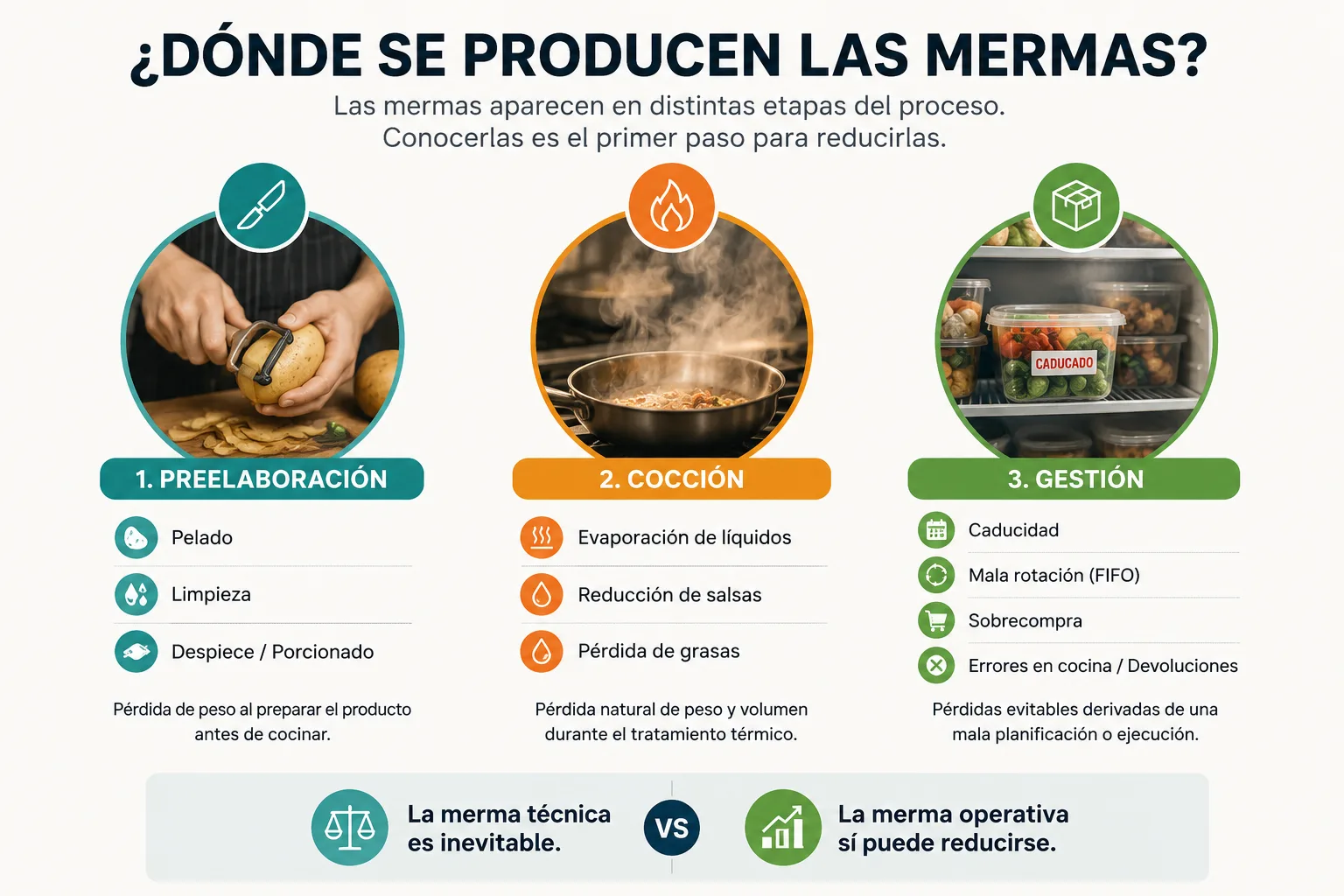
Understanding the nature of each type of waste is the first step to stop treating waste as a running expense and start seeing it as a performance indicator that requires constant monitoring. If you don't know which part of your product was lost "by nature" and which was lost "by management", you are operating blind on your own profit margin.
How to calculate food waste in hospitality
If you don't measure, you don't control; and if you don't control, you are leaving money on the table every day. In the day-to-day of a professional kitchen, it is very easy to fall into routine and normalize that, after cleaning a sack of potatoes or breaking down a tenderloin, the final weight is lower than what you bought. The problem is that if you don't calculate that yield percentage, you are working with theoretical costs that don't match reality.
Yield is, basically, the percentage of product we actually use for the final dish. Imagine you buy 10 kilos of a product and, after processing it, you have 8 kilos left. That 20% that has disappeared is your waste. Knowing exactly what that percentage is is vital to adjust your menu prices: if you don't take it into account, your real profit margin will always be lower than what your cost sheet shows.
This is where the recipe cost sheet comes into play. It is not just another document to keep in a drawer; it is the instruction manual for your profitability. At Prezo we always say that, without a well-defined cost sheet, any calculation is a rough estimate. The sheet must record, gram by gram, the gross weight (what comes through the warehouse door) and the net weight (what reaches the plate). If everyone in the kitchen follows the same cleaning and portioning process, your yield will be constant and your costs predictable.
The basic waste cost formula
To go from intuition to data, you only need to apply this simple formula to find out the yield of your product:
(Net Weight / Gross Weight) × 100 = Yield %
For example, if you buy a kilo (1,000 g) of artichokes and, after removing the tough leaves and stems, you have 700 g left, the calculation is (700 / 1,000) × 100. Result: you have a 70% yield. That means 30% of the product you paid for has turned into waste.
And how do you work out the real cost? Once you have that percentage, you adjust the purchase price. If a kilo of artichokes costs you €3, but you only use 70%, the real cost of the net product is no longer €3, but €4.28. Doing this exercise with your star products will give you a completely different perspective on the real profitability of your menu.
And if you want to go deeper into the subject, you can read this: Zero-waste inventory: how to turn food waste into sustainable opportunities.
Effective strategies to reduce food waste
Reducing waste is not only a matter of "cooking more carefully"; it is a management strategy that runs through the entire process, from the order placed with the supplier to the moment the dish reaches the table. If you want to optimize your restaurant's profitability, you need to move from reactive to proactive management.
Here are the fundamental pillars to start gaining ground on waste:
- Standardizing kitchen processes: the lack of uniformity is the main enemy of yield. If each cook cleans the product in a different way, your costs will fluctuate every day. Create visual manuals or mandatory preparation cost sheets. When the whole team knows exactly how to handle the product, yield becomes constant and predictable.
- Smart purchasing management: the most common mistake is buying out of habit instead of buying based on demand. It is crucial to analyze your sales history before placing an order. If you buy more than you need, you are buying "future waste" that will end up in the bin due to expiry or spoilage. Adjusting your purchase volume is the fastest way to improve your cash flow.
- Strict rotation control (FIFO): it's basic, but it remains a critical point in many kitchens. The First In, First Out system must be a religion: the product that comes in first is the one used first. Organize your warehouse and your fridges so that the oldest product is always accessible.
- Impeccable goods reception: the fight against waste starts the moment the supplier's truck unloads at your door. If you accept product that already arrives in poor quality or with an expiry date that is too tight, you are taking on a loss that isn't yours. Check, weigh and, if necessary, return it.
- Team training: your team is the one managing your money every day. If they don't understand how every gram they throw away affects the restaurant's bottom line, they will hardly get involved in saving. Communicate this data, make them part of the reduction goal and you will see how waste becomes a shared concern.
In the end, it's about making every action in your restaurant based on data and not on habit. When you eliminate "improvisation", the room to reduce waste multiplies.
Stock control and digitization: the role of technology
If you try to control stock and waste with pen and paper, or even with spreadsheets that don't update in real time, you will always be one step behind. Technology, specifically platforms like Prezo, transform that complexity into a simple and, above all, profitable process.
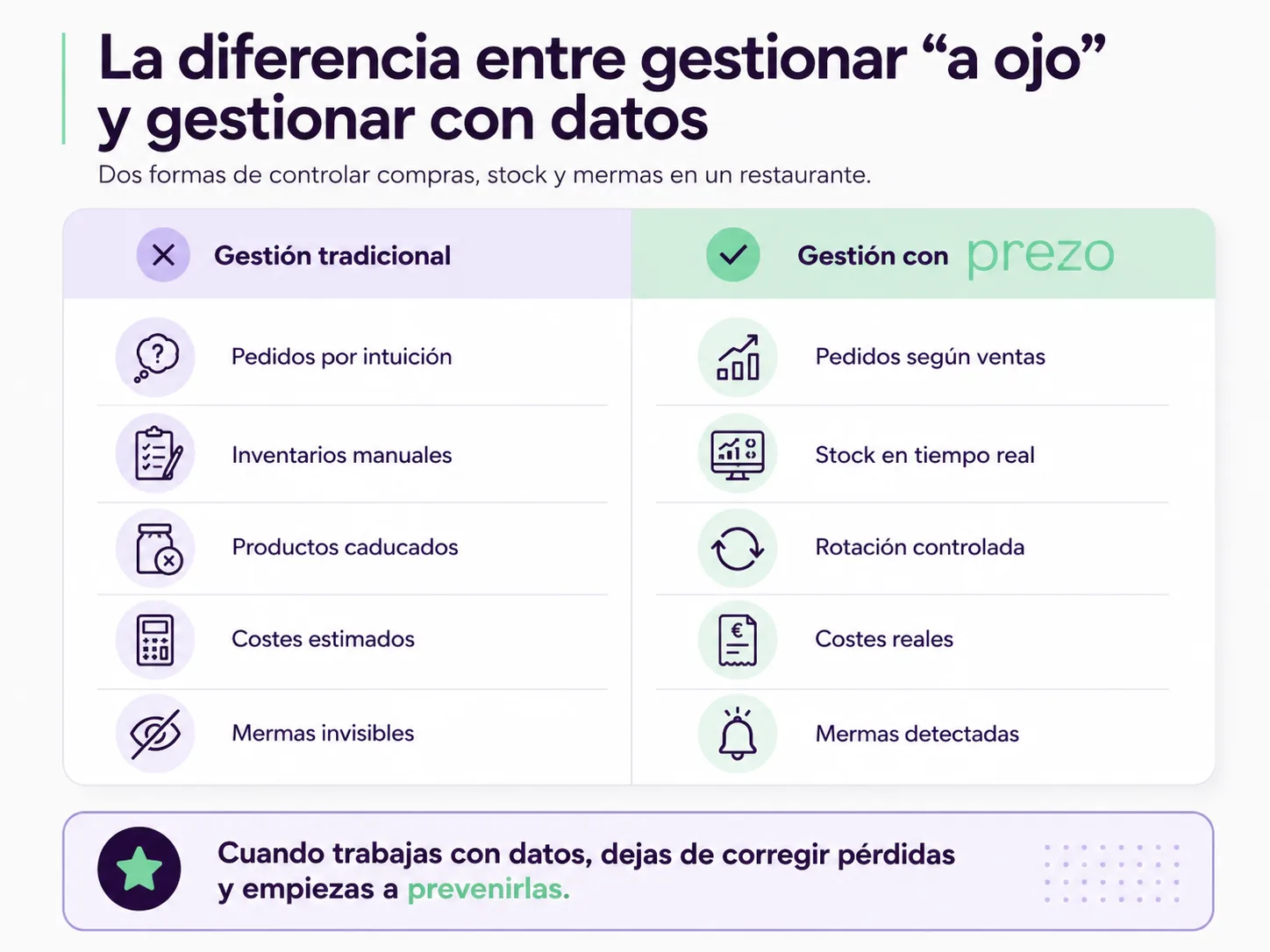
The key is not just "recording" what comes in, but automating the intelligence behind every order. When you digitize management with Prezo, something magical happens for your bottom line:
- Full real-time visibility: you know exactly how much stock you have in your fridges and warehouse without doing endless inventories every week. With this control, the system detects deviations instantly, allowing you to identify if waste is spiking in a specific area before it becomes a serious problem.
- Predictive ordering: forget about placing orders out of habit or trying to remember how much you ordered last Tuesday. Prezo cross-references your sales history with your current stock and suggests what to buy to cover your real demand. It's the end of overbuying, the number one cause of "future waste".
- Delivery note digitization: by integrating your orders and goods reception digitally, you ensure rigorous cost control from minute one. You avoid invoicing errors and, most importantly, you make sure the quality of the product entering your kitchen is the one you need to maintain your standards.
In a way, integrating this technology is like giving your restaurant a "co-pilot" that works 24 hours a day to look after your margin. It's no longer about working harder to compensate for losses, but about managing more intelligently.
Frequently asked questions (FAQ)
How often should I measure food waste in my venue?
To reduce food waste effectively, the ideal is to integrate control into your daily routine. There's no need to overcomplicate it: if you digitize your management with Prezo, you get real-time data without wasting hours on manual inventories. If you detect a spike in your restaurant's waste, you'll know where the problem is before it affects your bottom line at the end of the month.
Is it normal to have a certain level of waste in the kitchen?
It is natural to have an inevitable technical waste (such as peelings or bones), but any loss that exceeds the standards of your cost sheet is an avoidable expense. If your restaurant's waste is high, it's a clear sign that something is failing in your planning. The key to reducing food waste is to identify which part of it is operational so you can correct it immediately through better purchasing and stock control.
How does Prezo help avoid product waste?
Prezo eliminates buying "on intuition". By analyzing your sales history, the system helps you place orders much more closely matched to real demand, avoiding the excess stock that usually ends up expiring. By buying only what you need, you protect your profit margin and eliminate that "future waste" that costs the sector so much money.
Is it very complicated to implement a waste control system?
At first it may seem overwhelming, but with the right technology the process is dramatically simplified. At Prezo we have designed our platform so that purchasing management and stock control are intuitive, allowing any team member to record information quickly while you keep full control of your costs.