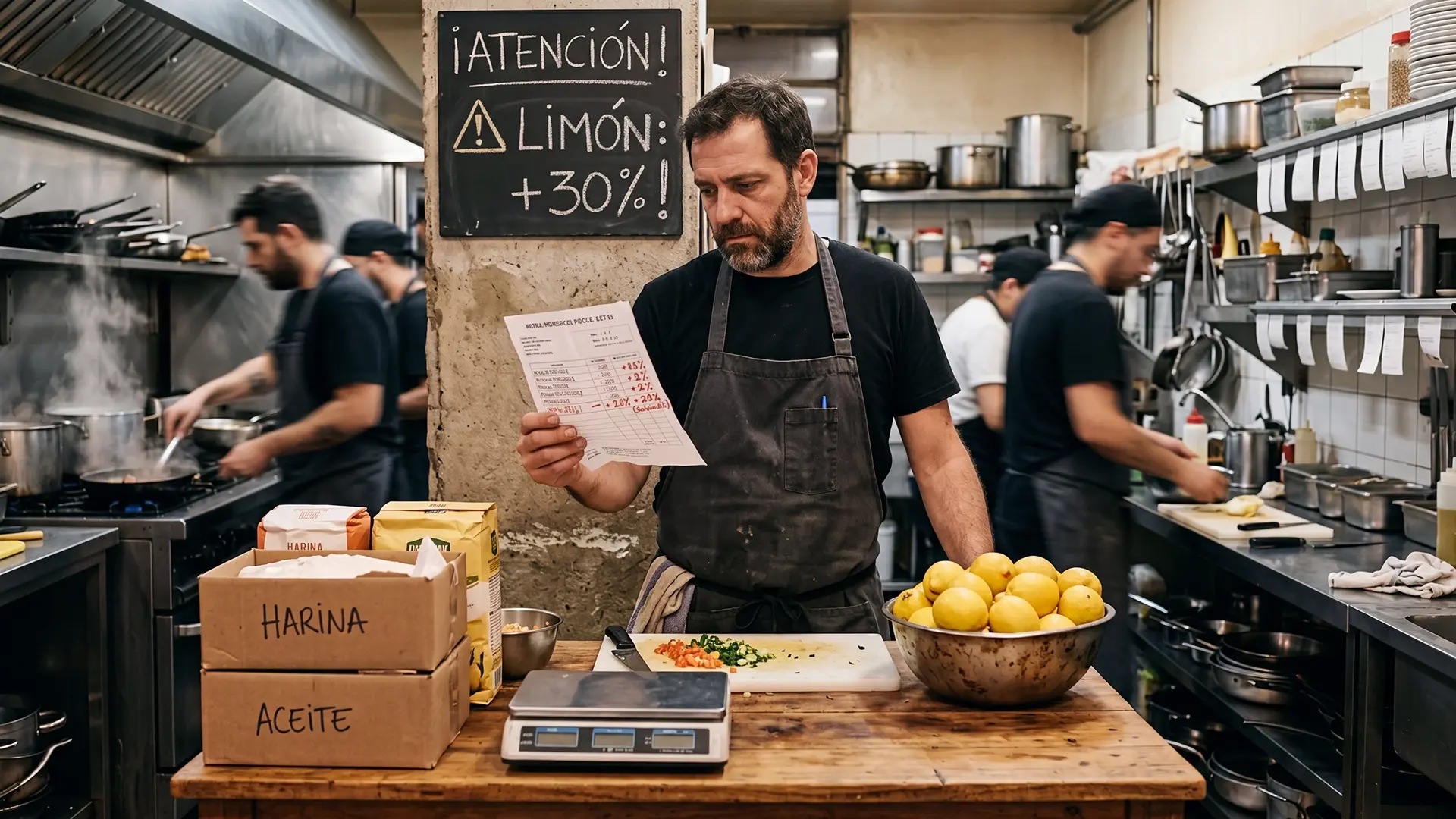

Lemons are up 29.7% in a year. You know this because it made the news: the harvest dropped, citrus production collapsed by 11%, and suddenly the price went from €2.69 to €3.59 a kilo in some supermarkets.
And that's exactly where the problem is. Not in the lemon.
The lemon is the price hike you see. But of all the items coming into your kitchen every month, how many others have gone up 5%, 8%, or 12% without anyone recording it? I've spent years seeing the same thing in restaurants that, on paper, are doing everything right: their margin slips away through the increases that never make the headlines.
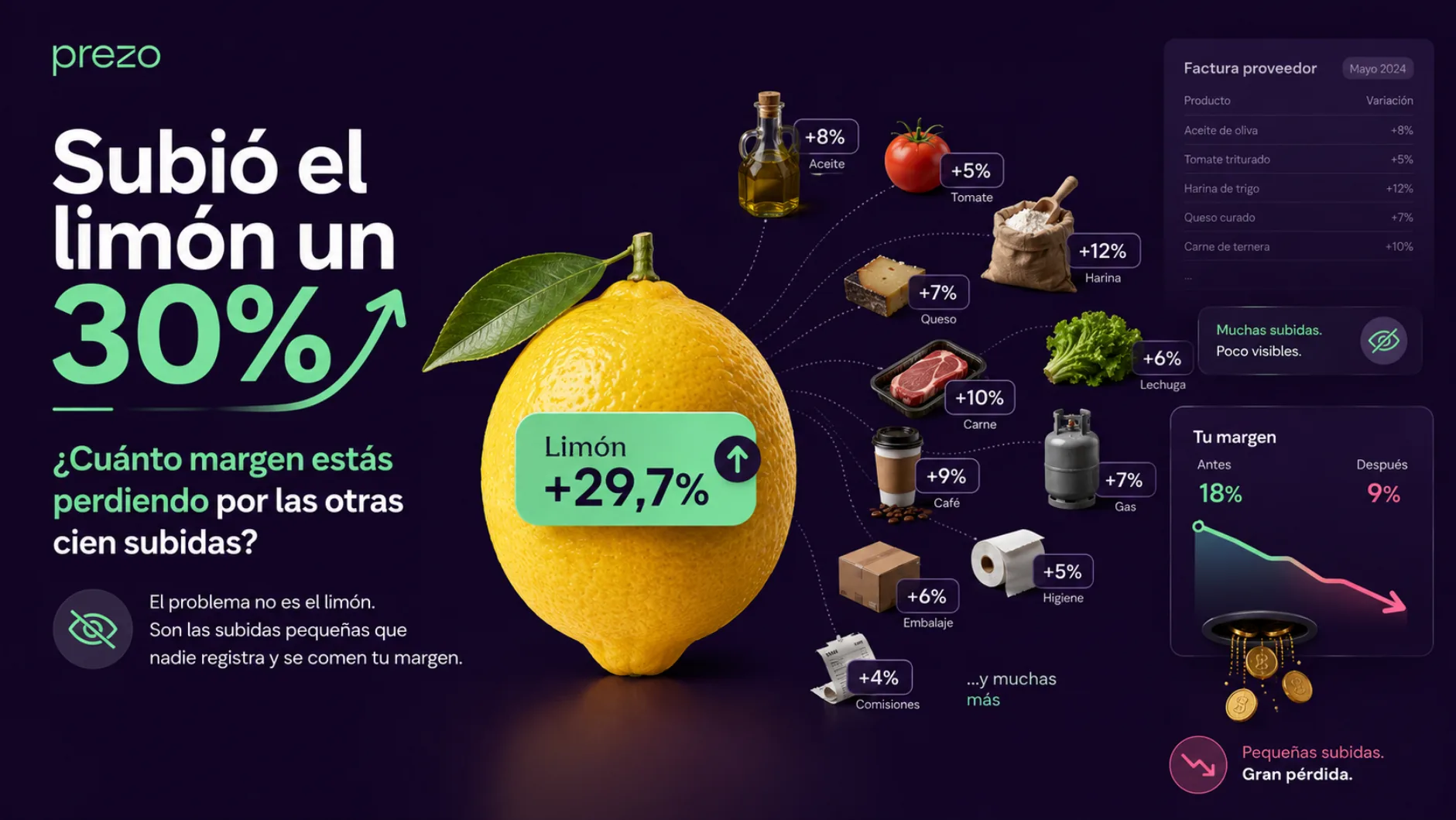
In this article I'll explain where that money leaks out, what you should know every time a supplier adjusts a price, and how to set up a system to detect it instead of finding out three months too late.
The lemon is the hike you see (and that's exactly why it's the least dangerous)
A price hike that makes the news is, paradoxically, the one that hurts you least. Because you see it coming. You spot it, you talk it over with your team, you decide whether to tweak the dish or absorb it. You have room to react.
The real danger is something else: the dozens of small adjustments your supplier makes every month that slip in through the delivery note without a sound. 6% on the oil. 9% on the cheese. 4% on the flour. None of them is news. None, on its own, alarms you.
But they add up. And while you keep selling the same dish at the same price, the cost underneath moves on its own. There's no specific day on which you «lose» money: you lose it drop by drop, serving by serving, over months, until you see it reflected in a profit-and-loss statement that doesn't match what you thought you were earning.
The lemon makes the news. Those other hundred hikes that touch your margin don't.
How a price hike erodes your margin without you noticing
Margin erosion is almost never a single blow. It's a leak. No supplier is going to call to warn you that your star dish just stopped being profitable: the price simply changes in one place and nobody cross-checks it against the price in the other. The cost goes up on one side and the menu price stays exactly where it was. That gap, which starts out as cents, is what slowly eats into your profitability month after month without showing up anywhere obvious.
The invisible journey: from delivery note to your bottom line
Think about the real journey of a price hike. The supplier adjusts the price. The delivery note arrives in your kitchen with the new figure. Someone files it, or jots it down, or not even that. The ingredient is used the same as yesterday, the dish is served the same as yesterday, and it's charged the same as yesterday.
At no point in that chain is there a moment when someone stops to say: «this ingredient has gone up, which dishes use it and how much margin did I just lose?». It's not a one-off mistake or anyone's oversight. It's that there's nothing set up to detect it. The hike travels from the delivery note to your bottom line without any system recording it along the way, and you only see it when it's already a hole, not while it's still a one-cent correction.
How much money really evaporates
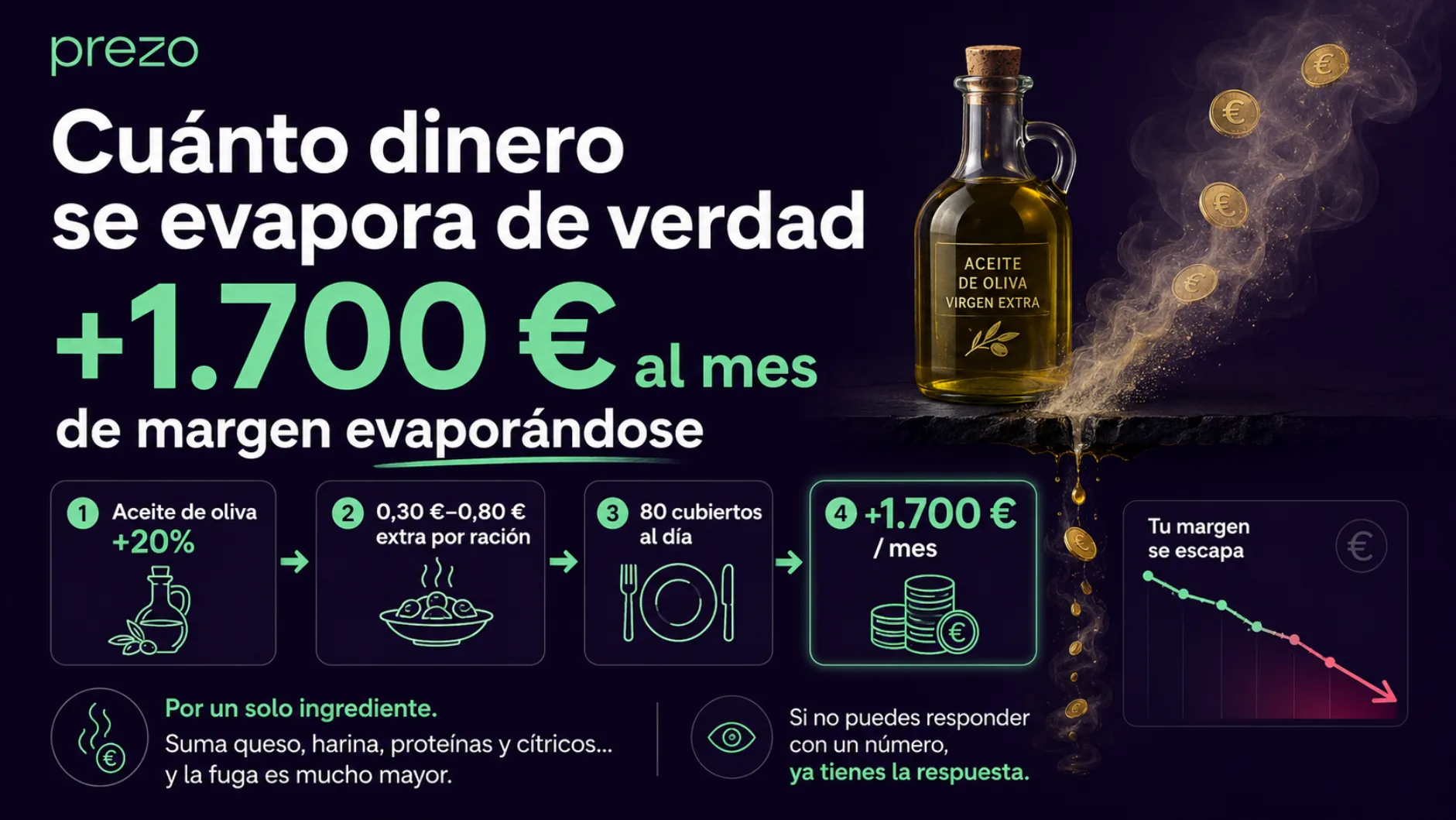
Let's put some numbers on it, because in the abstract this isn't scary enough. Imagine olive oil goes up 20% and you don't update your recipe cards. Depending on the dish, that's between €0.30 and €0.80 of extra cost per serving you're no longer passing on.
It seems like little. Multiply it. In a restaurant serving 80 covers a day, that difference becomes more than €1,700 of margin a month evaporating from a single ingredient. And oil is just one. Add the cheese, the flour, the proteins, the citrus. The question stops being «how much did the lemon go up?» and becomes a far more uncomfortable one: how much am I losing right now, this month, to increases I haven't recorded? If you can't answer with a number, you already have your answer.
What you should know in under a minute when an ingredient goes up
Let me frame it as a test. The price of an ingredient goes up and you have sixty seconds to answer three questions. If you can't, it's not that your memory is failing: it's that you lack a system.
👉 First: which dishes that hike affects. Not «roughly which ones», but the exact list of menu items that use that ingredient, because a lemon hike doesn't hit a dish that uses it as a garnish the same way as one that uses it as a base.
👉 Second: how much the margin drops per dish. In euros and as a percentage. Knowing that «the cost is going up» is useless; what drives decisions is knowing that the dish went from giving you a 68% margin to a 61% one.
👉 And third: whether you're better off adjusting the price or changing the recipe. Sometimes the answer is to tweak the menu price. Sometimes it's to swap an ingredient or revisit the portion size. But that decision is only a good one if you make it with the number in front of you, not by gut feel.
When an ingredient goes up you should have those three answers instantly. Most restaurants have them at month-end, and by then you can still change the price, sure, but you can't change what's behind you: every dish you served undercharged during those weeks is already served and already charged. That margin doesn't come back. Reacting late costs you everything you sold while you didn't know you had a decision to make.
Why managing costs "by eye" (or in Excel) has stopped working
This is where a lot of people push back: «but I've got my recipe costings done». And it's true, almost everyone does. The problem is they did them once, the day they set up the menu, and that's where they stayed. A costing from eight months ago doesn't tell you what your dish costs today: it tells you what it cost when you calculated it. And in between, a hundred delivery notes with different prices have come in.
Excel looks like the solution and it's exactly where it breaks. It works the first month. But all it takes is one ingredient's price changing for you to have to go, card by card, hunting down every dish that uses it and redoing the math by hand. Nobody does that every week. So it doesn't get done, and the spreadsheet becomes an old snapshot that gives you a false sense of control.
Having costings isn't the same as having your food cost under control. The first is a document. The second is a system that updates itself when a price changes. And «by eye» is neither of those two things: it's operating blind and calling it experience.
The dynamic costing: the only way not to operate blind
The alternative isn't to do more Excel or review cards with more discipline. It's to change the very nature of the costing: going from a fixed snapshot to a living system.
A costing is, simply, the card that calculates the real cost of a dish: each ingredient, its quantity, its trim loss, and its purchase price. And the food cost is the percentage that cost represents of the selling price. In hospitality, healthy usually sits between 28% and 35%. Nothing new so far.
The difference is in the word «dynamic». A dynamic costing is one that updates itself the moment an ingredient's price changes. The new delivery note comes in, and instantly you know which dishes have become more expensive and how much margin you've lost on each. You don't wait until month-end. You don't redo anything by hand. The system cross-checks the new price against your recipes and gives you the three numbers from the start without you having to ask for them.
Theoretical food cost vs. real food cost: where the leak hides
There's a second level almost nobody looks at, and it's where the real money is buried. The theoretical food cost is what your dishes should cost according to your costings. The real food cost is what they actually cost you, based on what you consumed from the storeroom.
Those two numbers almost never match. And the difference between them has a name: variance. Servings more generous than they should be, trim loss nobody controls, purchasing mistakes, product that gets thrown out. A variance of more than 3% is already an alarm. If you only look at the theoretical figure, you see a restaurant that on paper makes money while the till tells you otherwise, and you don't understand why.
How often you should update your costings
The right question isn't «every how many months», it's «how often do your prices change». And the answer is: constantly.
The practical rule: update whenever an ingredient that genuinely weighs in a dish goes up more than 5%, and at a minimum, review everything every quarter. Although, to be honest, if you have to put a date in the calendar to do it by hand, you're already late. The logical thing is for it to update itself the moment you record the delivery note, and for you to just decide what to do with the figure.
Raise the price or change the recipe: how to decide without losing customers
Once you have the figure, the decision arrives. And here the most expensive mistake is the most common one: raising the whole menu 5% in one go because «everything has gone up». It's the reaction of someone who doesn't have the numbers dish by dish, so they apply a uniform percentage and pray. The customer notices it, perceives it as a blanket hack, and you've touched prices that didn't need touching.
With the margin dish by dish in front of you, the decision is surgical. Not all dishes adjust the same way: each one moves according to how much the hike affects it and the role it plays on your menu. This is menu engineering, and it rests on two questions per dish: how much margin it leaves and how much it sells.
Your star dish (the one lots of people order and that also leaves you a good margin) can take a small hike without anyone batting an eye. A dish that sells little and now also loses margin maybe doesn't need a price rise, but to leave the menu or change recipe. And sometimes the best move isn't the price at all: it's swapping the ingredient that shot up, revisiting the portion size, or redesigning the dish to lean on what is profitable. Raising prices with strategy doesn't scare customers off. Raising them blind does.
How we solve it at Prezo
Everything I've told you so far is, basically, the reason we built Prezo. We didn't start from «let's make some software»; we started from seeing this problem over and over in restaurants that worked incredibly hard and didn't understand why that effort wasn't turning into margin.
The idea is simple: you record the delivery note and the system does the rest. It cross-checks the new price against your recipes, tells you which dishes have become more expensive, how much margin you're losing on each, and where you need to decide whether to touch the price or the recipe. The costing stops being an Excel you update when you remember and becomes something living that moves on its own when your costs move.
It's not about managing more, it's about no longer managing blind. You'll keep seeing the lemon hike in the news. The difference is that the other hundred you'll see on your screen, the day they happen, not at month-end.
Frequently asked questions
How much does a restaurant lose when an ingredient goes up?
It depends on the weight of that ingredient in each dish, but the loss is greater than it seems because it accumulates with every serving. An ingredient that goes up 20% without updating the recipe cards can mean between €0.30 and €0.80 of extra cost per dish; in a restaurant serving 80 covers a day, that's more than €1,700 of margin a month from a single product. The serious part isn't the one-off hike, but the time that passes before you detect it.
How often should I review my costings?
Whenever an ingredient with real weight in a dish goes up more than 5%, and at a minimum once per quarter. In practice, supplier prices change constantly, so the ideal is for the costing to update itself the moment you record the delivery note, rather than relying on a manual review in the calendar.
How do I know which dishes a price hike affects?
You need to cross-check the ingredient's new price against your menu recipes to see in which dishes it appears and in what quantity. Doing it by hand, card by card, is unworkable every week; that's why a dynamic costing gives you that list instantly, along with how much the margin drops in each affected dish.
Is it better to raise the price or change the recipe?
There's no single answer: it depends on how much margin the dish leaves and how much it sells. A very popular and profitable dish can take a small price rise; one that sells little may call for a recipe change, a portion-size adjustment, or leaving the menu. The decision is only a good one if you make it with the margin per dish in front of you, not by applying a uniform percentage to the whole menu.
Can I control costs in Excel or do I need software?
Excel works the first month and breaks as soon as prices change, because you have to redo each card by hand and nobody sustains it over time. For a small, stable menu it can be enough; once you have dozens of dishes and suppliers adjusting prices every week, software that updates the food cost automatically stops being a luxury and becomes what protects your margin.